
Blogs
Best Photography Spots in Paris: 15 Must Visit Places for Amazing Photos
Paris is one of the most photographed cities on earth and one of the easiest to photograph badly.
The reason is almost never equipment. It is that the famous viewpoints are at their best for about twenty minutes a day, and most visitors arrive in the middle of the afternoon when the light is flat, the crowd is at its peak, and the building is lit from the wrong side.
This guide to the best photography spots in Paris gives you fifteen places worth the walk, and for each one the hour that makes it work. Everything here is reachable without special access, nothing requires a drone, which is banned over the city anyway, and the whole list can be covered across two well-planned evenings and one early morning.
There is also a short section at the end on the rules that catch photographers out here, including one about the Eiffel Tower at night that surprises almost everyone.
Before the list, two things that matter more than any of the locations, and more than any camera you bring.
This is also a list written for a working trip rather than a photo expedition. Every spot sits on a route you would plausibly walk anyway, and the timings assume you are also eating, sleeping and seeing the city rather than chasing light for a week.
The Two Rules That Matter More Than the Locations
Shoot at blue hour, not sunset. The twenty to forty minutes after the sun goes down, when the street lights are already burning and the sky is still deep blue rather than black, is when Paris looks the way people remember it. In late December that window falls around 4:45 to 5:30 in the afternoon. In June it is close to ten at night. Everything on this list improves in it, and several things on this list only work in it.
Go early or go late, never in between. The famous viewpoints are quiet before nine in the morning and busy from eleven until five. Sunrise at Trocadéro and Montmartre is a different experience from the same place at noon, and it costs nothing but an alarm.
Apply those two rules and the list below becomes a plan rather than a wish list. Ignore them and the best photography spots in Paris will give you the same photographs everyone else took that afternoon.
The Fifteen Spots, and the Hour for Each
| # | Spot | Best hour |
| 1 | Trocadéro | Blue hour or sunrise |
| 2 | Avenue de Camoëns | Early morning |
| 3 | Pont de Bir-Hakeim | Just after sunset |
| 4 | Champ de Mars | Any, best late afternoon |
| 5 | Pont Alexandre III | 30 minutes after sunset |
| 6 | Arc de Triomphe rooftop | Sunset |
| 7 | Place Vendôme | Evening |
| 8 | Rue de Rivoli arcades | After rain |
| 9 | Tuileries Garden | Late afternoon |
| 10 | Louvre pyramid | Blue hour |
| 11 | Galeries Lafayette dome | Late weekday morning |
| 12 | Steps below Sacré-Cœur | Sunrise |
| 13 | Rue de l’Abreuvoir | Before 9 am |
| 14 | Galerie Vivienne | Midday, rainy days |
| 15 | Notre-Dame from the river | Sunset |
1. Trocadéro
The definitive Eiffel Tower photograph, taken from the terrace between the two wings of the Palais de Chaillot, with the tower centred across the river.
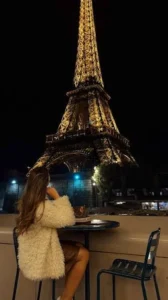
Come at blue hour for the classic shot, or at sunrise if you want it without several hundred people in the frame. The tower sparkles for five minutes on the hour after dark, and the crowd reacts, which is often the better picture.
2. Avenue de Camoëns
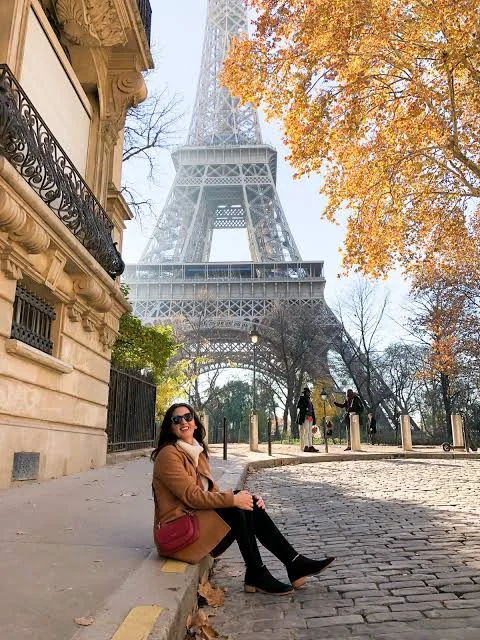
A short residential street in the 16th that ends in a staircase with the Eiffel Tower framed exactly between the buildings. It is small, quiet and consistently one of the best compositions in the city.
Early morning, before the light hits directly.
3. Pont de Bir-Hakeim
The two-level bridge with its metal columns, the tower framed through the arches, and a metro crossing overhead every few minutes if you wait for it.
Best just after sunset, and one of the few spots that works in rain, when the deck reflects.
4. Champ de Mars
Directly under and in front of the tower, for scale rather than skyline. Useful for putting people in the frame, and the only place on this list where being close is the point rather than a mistake.
Late afternoon in summer, when the lawns fill and the light comes across rather than down. In winter it works at dusk with the tower lit above you.
5. Pont Alexandre III
The most ornate bridge in the city, with gilded lamp posts, cherubs and the dome of Les Invalides behind it.
The half hour after sunset is the window, when the lamps are lit and the sky still has colour. Shoot along the bridge rather than across it.
6. The Arc de Triomphe Rooftop
From the top, twelve avenues radiate outward and the Champs-Élysées runs away in a straight line toward the Louvre, with the Eiffel Tower off to the right.
This is the only view in the city where you can photograph the tower and the avenue together, and in December the garlands along the avenue turn it into a single line of light. Sunset, with a ticket booked ahead, and be aware there is no lift for most of the climb.
7. Place Vendôme
Formal, symmetrical and far calmer than the avenue beside it. The column in the centre, the jewellers’ windows around it, and good reflections after rain.
Evening, once the shopfronts are lit.
8. Rue de Rivoli, Under the Arcades
A kilometre of repeating stone arches alongside the Tuileries, which becomes a long receding perspective the moment you stand in the right place.
Best after rain, when the pavement under the arches reflects the lights.
9. The Tuileries Garden
Bare trees and the Ferris wheel in winter, symmetry and water in summer, and the Louvre at one end with the Concorde obelisk at the other.
Late afternoon, shooting west toward the setting sun.
10. The Louvre Pyramid
The glass pyramid against the palace facade, and the pools around it that double everything when the water is still.
Blue hour, when the pyramid lights up and the courtyard empties. The inverted pyramid inside the shopping concourse is the wet-weather alternative.
11. Under the Galeries Lafayette Dome
The stained glass Art Nouveau dome from 1912, photographed straight up from the ground floor, with the balconies curving away.
Late morning on a weekday. Go up to the free rooftop terrace afterwards for a rooftop panorama toward the Opéra Garnier and the Eiffel Tower, which is one of the best free viewpoints in the city.
12. The Steps Below Sacré-Cœur
The whole of Paris spread out below, with the basilica behind you and the city facing you rather than side-on, which is what makes it different from the other high viewpoints.
Sunrise, without question. By eleven the steps are full, and by two in the afternoon the light is behind the city rather than on it. This is the single biggest gap between the early version and the late version of any spot in this guide to the best photography spots in Paris.
13. Rue de l’Abreuvoir, Montmartre
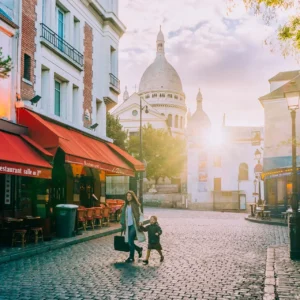
The cobbled curving street below the Montmartre vineyard, with Sacré-Cœur appearing above the rooftops at the right angle.
Before nine in the morning. Later than that and you are photographing other photographers.
14. Galerie Vivienne
A glass-roofed arcade from the 1820s with mosaic floors, a rotunda and a bookshop that has been there almost since it opened.
The answer when it rains, which in Paris it frequently does. Midday, when light comes through the glass roof.
15. Notre-Dame from Across the River
The cathedral reopened in December 2024 after five years of reconstruction, and the classic angle is from the Left Bank quays or the small square opposite, with the flying buttresses catching low light.
Sunset, from the river side. Better still, from the water, which brings us to the single most productive photography decision in Paris.
The Best Photographs in Paris Are Taken From the Seine
Three of the best photography spots in Paris on this list are bridges, and all three look better from below than from on them. A TripsMonster private Seine river cruise passes Notre-Dame, the Louvre, Pont Alexandre III and the Eiffel Tower in sequence, all lit, all from angles unavailable on foot.
Book the sunset departure rather than the late one, so the first half is blue hour and the second half is the lit city, and time it so the Eiffel Tower sparkles on the hour while you are on the water. Bring something to brace the camera against; boats move, and the exposures at that hour are long enough for it to show.
What the Season Does to This List
Winter and summer are two different shooting trips here, and it is worth knowing which one you have booked.
December to February. The best season of the year for the best photography spots in Paris, and the least obvious. Blue hour falls at a civilised hour, around 4:45 to 5:30 in the afternoon, so you can shoot it and still have dinner. The illuminations are up from mid-November, wet pavements reflect well, and the low sun produces long light all day rather than only at the edges.
June to August. Blue hour is close to ten at night, which means late finishes and early starts, since sunrise is before six. The compensation is that the sun is high enough to light the buildings’ faces rather than only their sides, and the city stays photographable for eighteen hours.
Spring and autumn. The compromise, and October in particular gives the best natural light of the year, with low golden sun and colour along the Seine.
How to Actually Shoot This List in Two Evenings
The constraint is not the locations, it is that blue hour lasts about half an hour and the fifteen spots sit across five arrondissements.
On foot, you will reach one of the best photography spots in Paris per evening, possibly two. With a vehicle waiting, you will reach four or five in the same window, which is the entire argument for a TripsMonster city tour by van as a photography tool rather than as a comfort.
A workable plan:
- Evening one. Arc de Triomphe rooftop at sunset, then Place Vendôme, Pont Alexandre III and Trocadéro for the sparkle on the hour.
- Morning one. Montmartre at sunrise for Rue de l’Abreuvoir and the steps below Sacré-Cœur, then Galeries Lafayette when it opens, then the covered passages if the weather turns.
- Evening two. Champ de Mars and Bir-Hakeim in the late afternoon, the Louvre pyramid at blue hour, then a Seine cruise for the bridges and the tower from the water.
TripsMonster builds exactly these routes around the light rather than the map, with a driver who knows where to stop, where you are allowed to stop, and how long the window lasts before it closes. In winter that matters more, because the whole window falls inside rush hour. Book on the tours page, or send your dates through Custom Your Trip or to info@tripsmonster.com and say photography is the priority, and the itinerary comes back timed to blue hour rather than to opening hours.
Practical Rules Worth Knowing
Drones are banned over Paris. Do not plan around them.
Tripods are restricted at most monuments and inside most museums. A small travel tripod is tolerated in public spaces, and a beanbag or a wall is more reliable.
The Eiffel Tower at night is a special case. The daytime structure is out of copyright, but the night light display is a protected work, so photographs of the illuminated tower are fine for personal use while commercial use requires authorisation. Worth knowing if you sell your images.
Flash is prohibited in most museums, including the Louvre, where a private tour at least gets you to the quieter rooms where a hand-held shot is possible.
Versailles is worth a separate morning if interiors are your subject. The Hall of Mirrors at opening time, before the coach groups arrive, is one of the hardest and most rewarding rooms in France to photograph, and TripsMonster Versailles tours with prebooked entry put you in it early rather than at eleven with everyone else.
Watch your bag while you shoot. Distraction is exactly how pickpockets work, and a photographer at a viewpoint, looking through a screen with a bag open at their feet, is the most distracted person there. Trocadéro and the steps at Sacré-Cœur are both known for it.
Check what is closed before you plan an interior. The Louvre shuts on Tuesdays and Versailles on Mondays, which is the most common way a photography morning gets wasted. Our Paris travel guide lists the rest.
Frequently Asked Questions
Where is the best place to photograph the Eiffel Tower?
Trocadéro for the classic centred view, Avenue de Camoëns for a framed composition without crowds, Pont de Bir-Hakeim for the bridge arches, and from the Seine for the angles unavailable on foot.
What is the best time of day for photos in Paris?
Blue hour, the twenty to forty minutes after sunset, which is around 4:45 to 5:30 pm in late December and close to 10 pm in June. Sunrise is the second best window, and it is the only one that gives you empty famous viewpoints.
Can you fly a drone in Paris?
No. Drone flights over the city are prohibited, and the restriction is enforced.
Do I need a professional camera for these spots?
No. Every spot on this list works with a phone, provided you are there at the right hour. Timing beats equipment at all fifteen of them.
How many days do I need to photograph Paris properly?
Two evenings and one early morning covers this list. Three days gives you a second attempt at whichever evening the weather ruins, which in Paris is a realistic possibility in any season.
Is it legal to sell photos of the Eiffel Tower?
Daytime photographs, yes. The night illumination is a protected work, so commercial use of the lit tower requires authorisation. Personal photographs and social posts are not an issue.
Can TripsMonster arrange a photography-focused itinerary?
Yes. Tell TripsMonster that photography is the priority when you send your dates, and the route is built around blue hour and sunrise with a vehicle between stops, rather than around the standard sightseeing order. Guides who work these routes daily also know where you are allowed to set up and where you are not.
Conclusion
The best photography spots in Paris are not secrets. Thirteen of the fifteen above appear in every guide to the city, and most visitors still come home with flat midday photographs of them. The difference is never the camera, and among travelers who care about their photographs it is rarely even the skill.
What separates the two outcomes is half an hour, and knowing which half hour. Be at Trocadéro at 4:45 in December rather than two in the afternoon, be on the Montmartre steps at sunrise rather than at lunchtime, and be on the water when the tower starts to sparkle.
If you would like the route built around the light instead of the map, send your dates to TripsMonster or call +33 6 22 35 95 91, and the evening is planned around the twenty minutes that actually matter. December visitors should read this alongside our Christmas in Paris guide, when blue hour and the illuminations fall at the same time.